Lost and Found


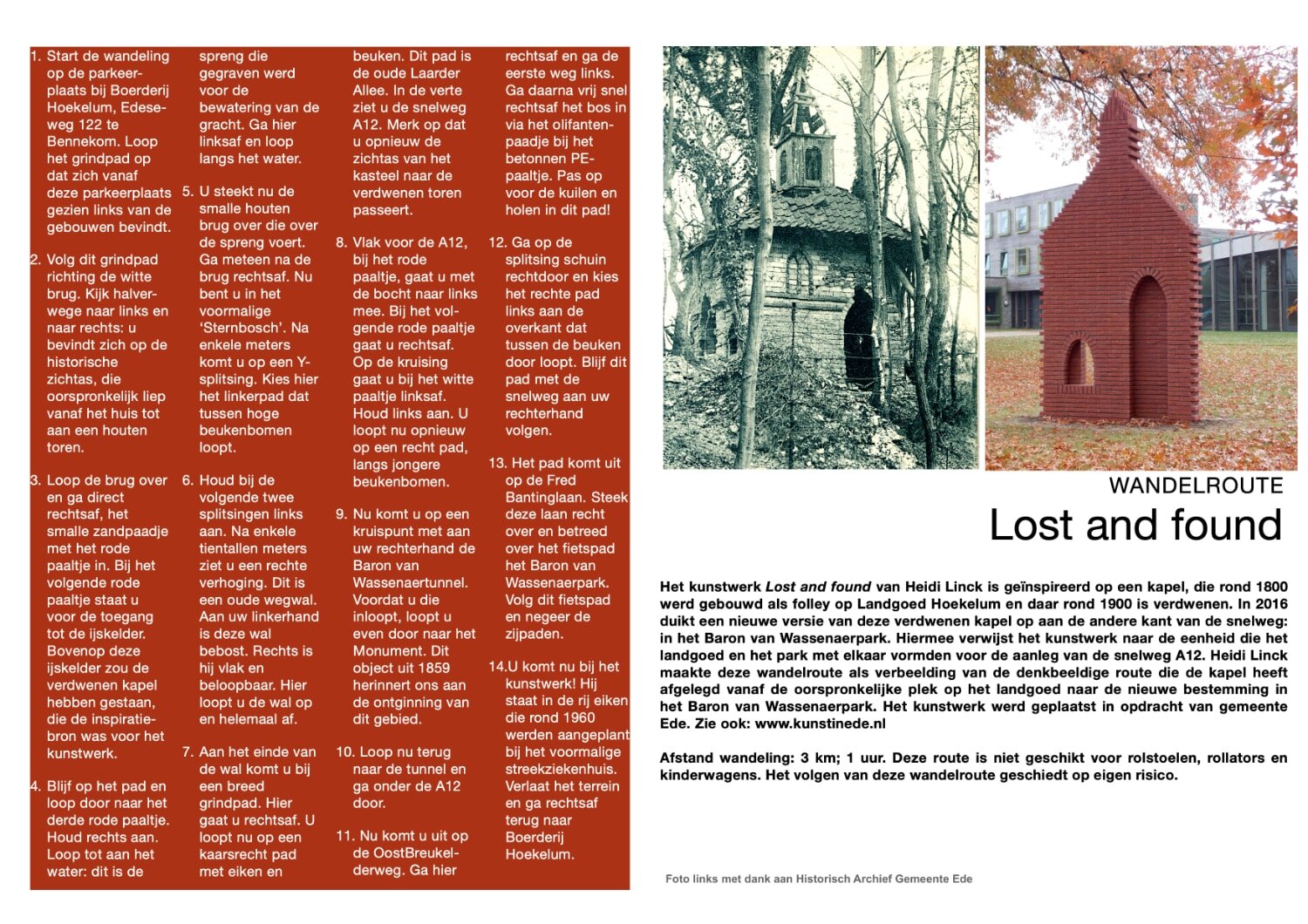

Het Baron van Wassenaerpark in Bennekom is vernoemd naar de eigenaar van dit landgoed vóór de Tweede Wereldoorlog. Toen de Duitse bezetter de A12-snelweg dwars door zijn aangelegde tuin bouwde, besloot de baron het gedeelte ten zuiden van de snelweg over te dragen aan de lokale gemeenschap, op voorwaarde dat er voor altijd zorgvoorzieningen zouden komen. Kort daarna werd er het regionale ziekenhuis gebouwd, en later andere zorginstellingen. Zo is dit voormalige deel van het landgoed getransformeerd van een historische landschapstuin tot een gebied vol functionele architectuur voor de gezondheidszorg. Lost and Found (2016) wil deze twee helften van het landschap weer met elkaar verbinden.
Tijdens mijn onderzoek in de archieven van het landgoed stuitte ik op een oude foto van een verdwenen folly: een klein, kapelachtig bouwwerk dat rond 1900 verdween. Op de plek waar de folly ooit stond, vond ik inderdaad resten van bakstenen en dakfragmenten, als stille getuigen van de verdwenen folly. Deze ontdekkingen vormden het uitgangspunt voor een nieuw kunstwerk aan de overkant van de snelweg: een hedendaagse herinterpretatie van de folly, geplaatst aan de 'verloren' kant van de tuin, in een rij rode eiken, een boomsoort die het landschap in de herfst in vuur en vlam zet. Het kunstwerk lijkt elk jaar even op te gaan in het gebladerte, alsof het deel is geworden van de seizoenen, van verlies en terugkeer.
Ook een wandelroute maakt deel uit van het project, die onder omwonenden werd verspreid en de denkbeeldige reis van de folly volgt: van de oorspronkelijke locatie op het landgoed naar de wedergeboorte in het park. Onderweg passeert de wandelaar plekken waar het landschap fluistert over vroeger gebruik, toe-eigening en transformatie.
The Baron van Wassenaerpark in Bennekom is named after the owner of this land before World War II. When the German occupier built the A12 motorway right through his landscaped garden, the baron decided to transfer the section south of the motorway to the local community, on the condition that the land would permanently house healthcare facilities. Shortly thereafter, the regional hospital was built there, and later other healthcare facilities. Thus, this former part of the estate has been transformed from a historic landscaped garden into an area brimming with healthcare architecture. Lost and Found (2016) connects these two halves of this landscape again.
During my research in the estate's archives, I came across an old photograph of a vanished folly: a small, chapel-like structure that disappeared around 1900. At the site where the folly once stood, I found remnants of brick and roof fragments, as silent evidence of the vanished folly. These discoveries became the starting point for a new sculpture on the opposite side of the highway: a reinterpretation of the folly, placed on the lost side of the garden, on a spot where a red oak once stood as part of a row of red oaks, a tree species that sets the landscape ablaze in autumn. The sculpture seems to dissolve into the foliage for a moment each year, as if it has become part of the seasons, of loss and return.
The work is accompanied by a walking route, distributed among local residents, that follows the folly's imaginary journey: from its original location on the estate to its reincarnation in the park. Along the way, the walker passes places where the landscape whispers of past use, appropriation, and transformation.
Lost and found
2016
Folly + walking route
Red brick, steel, concrete
210 x 40 x 432 cm
Design: Atelier Heidi Linck
Production in collaboration with: Van Grootheest Construction Company, Ede
Commissioned by the Municipality of Ede
Supported by the Mondriaan Fund