At the treshold of the inner space
There is a moment, just before a space unfolds, when everything seems possible. A breath between outside and inside. As I look at the model before me, that moment returns: it feels as though the space does not present itself to me, but asks me back. Not to enter, but to consider where “entering” truly begins.
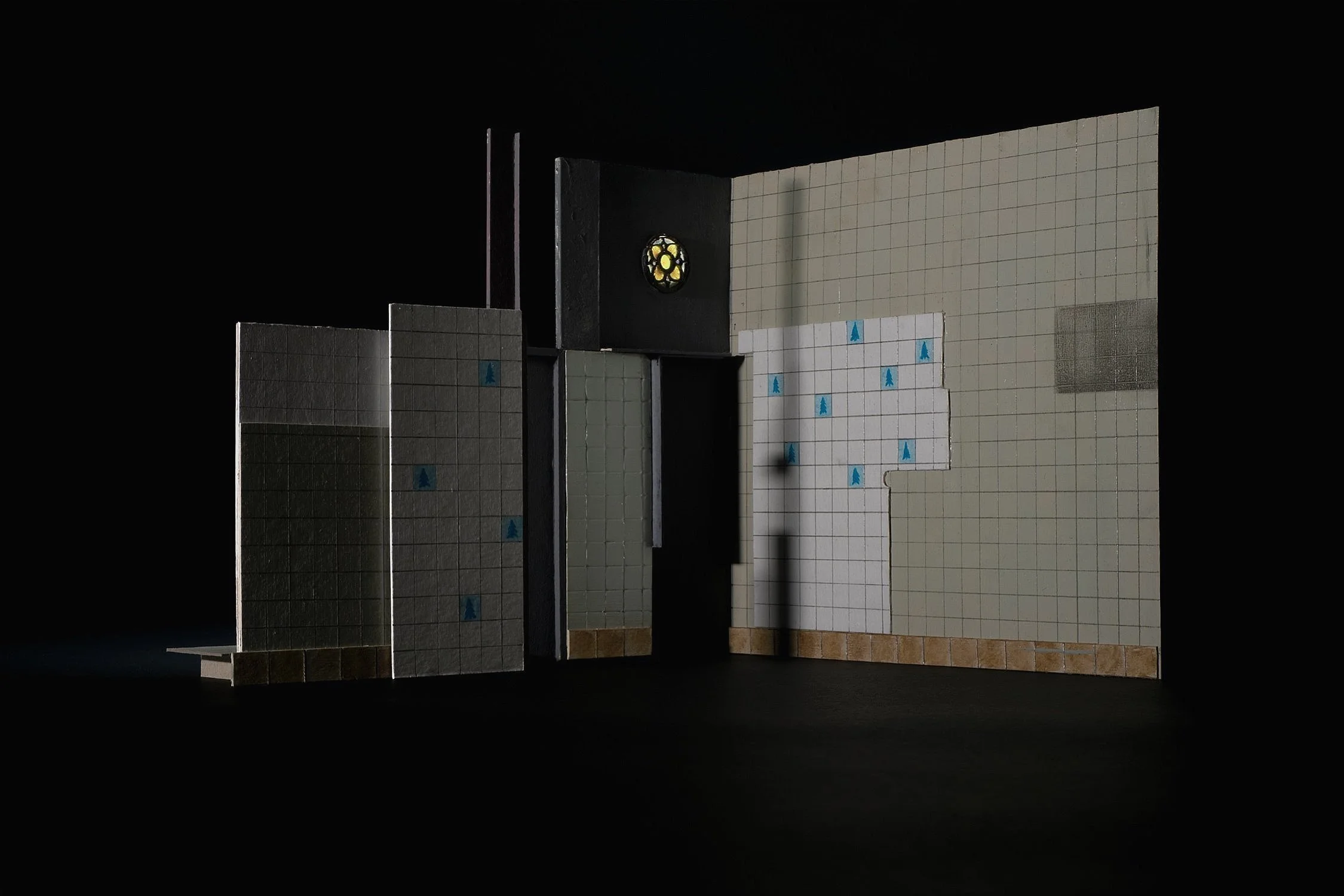
Pounding shadow 12 | 2023
Gaston Bachelard writes in The Poetics of Space (1958)* that entering a space proposed by a poet is a movement inward: a shift from the outer world into one’s own interior rooms. He states that our soul is an abode, and by remembering houses and rooms, we learn to live inside ourselves.
Remembering houses and rooms is key in my practice, as most of my models are based on places that no longer exist. They are fragments of vanished interiors, echoes of architectures that once carried meaning. Since they remain physically closed, as places, they can only be entered through imagination.
And this is exactly why the threshold matters so deeply. The threshold is not a line but a field: an extended zone where seeing turns into inner observation. It is the area where the gaze begins to bend, where I feel invited to make a choice to be observer of the outside world or inhabitant of my own inner space. In my photography, the space around the model is as equally important as the object itself, as this is the treshold space. Instead of pulling me directly into an interior, my photoworks bring me to the threshold, at which it is not yet certain whether I will enter or remain outside.
In that instant, the model can be both: object and space, something solid and something open.
This duality may mirror my position: I stand both before the space and within myself. The image becomes a portal, but the portal opens inward.
Here a secret room may appear. A room of new insights, a room of old shadows, or a quiet room I had forgotten I could find shelter in. Perhaps it is even a room for which my imagination is the only key.
In his book, Bachelard mentions Françoise Minkowska, a psychologist who used the imagination of houses to analyse one’s psychic state. And yes, as I build, play with light and dark, photograph, and look again, I indeed realize how my practice is connected to my own inner space. Before beginning any new work, I descend into a depth where silence, isolation and calm accompany me, when I also meet my fears, uncertainties and melancholy. My models not only represent a place that once existed, but also me.
And this is why I believe that every landscape needs a ruin. Because we need the space around it. Let’s go to that crumbled building near the river, where you have always felt curious about, yet never entered. Walk around it, dwell in the threshold space. What inner room opens inside you when you peer through that window?
_
*Gaston Bachelard - La poétique de l’espace - 1958 - Presses Universitaires de France, Paris.
Would you like to be updated on future notes? You are welcome to sign up for my Studio Notes.